



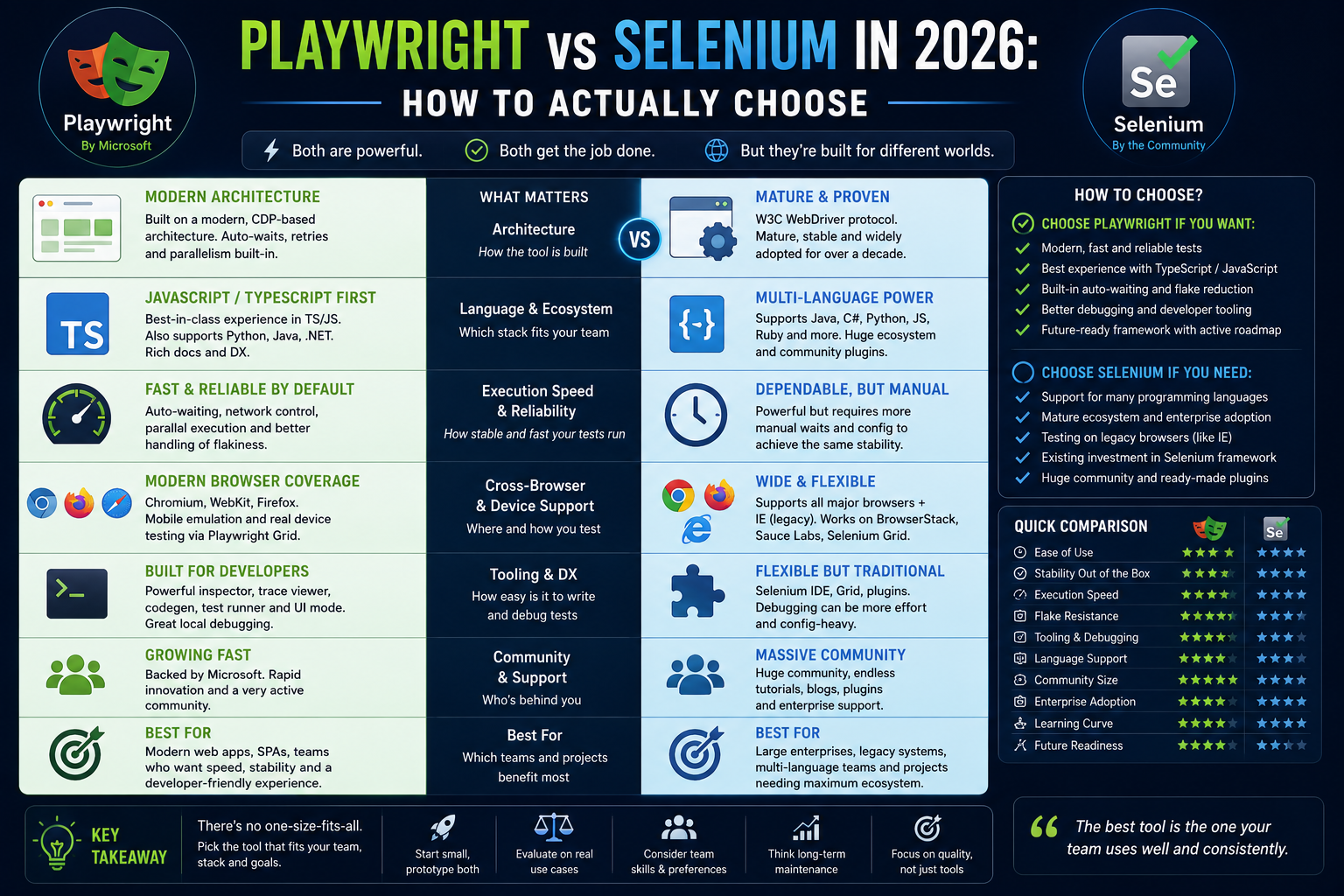
Choose Playwright when you're building a new suite for a modern web app: auto-waiting, trace viewer debugging, parallel workers out of the box, and one API across Chromium, Firefox, and WebKit make it the faster path to a stable suite. Choose Selenium when you need its unmatched ecosystem breadth, legacy browser coverage, massive grid infrastructure, or an existing investment your team already maintains well.
Key Takeaways
- Choose Playwright for new suites on modern apps; choose Selenium for ecosystem breadth, legacy coverage, or a healthy existing estate.
- The framework matters less than the architecture around it: selector contracts, data isolation, CI discipline.
- A stable Selenium suite is an asset, stabilize it; don't rewrite for fashion.
Head to head
| Dimension | Playwright | Selenium |
|---|---|---|
| Waiting strategy | Auto-waiting built in | Explicit waits you assemble |
| Browsers | Chromium, Firefox, WebKit | All majors + legacy via drivers |
| Languages | TS/JS, Python, Java.NET | Java, Python, C#, Ruby, JS |
| Parallelism | Workers out of the box | Grid you operate (Docker-ready) |
| Debugging | Trace viewer replays | Logs + screenshots + tooling |
| Ecosystem age | Fast-growing, modern | Twenty years of answers |
| Best fit | New suites, modern SPAs | Enterprise estates, huge matrices |
The history that explains the present
Selenium invented browser Automation as we know it: born in 2004, it fought the browser wars, standardized into the W3C WebDriver protocol, and built the largest Automation ecosystem in existence. Its architecture reflects that history, a wire protocol between your code and a driver binary per browser, which is why waits, sessions, and grid plumbing are your problem to assemble.
Playwright arrived in 2020 from the team that built Puppeteer at Google, hired into Microsoft. It skipped the protocol generation entirely: one library speaks directly to browser engines over their debugging protocols, which is why auto-waiting, network interception, and tracing feel native rather than bolted on. Neither history makes one tool better, but they explain exactly where each is strong.
Why auto-waiting changes the flake math
The largest single source of E2E flake is timing: the test acts before the app is ready. Selenium answers with explicit waits, powerful, but every wait is a decision an Engineer must make correctly, thousands of times across a suite. Playwright inverts the default: every action auto-waits for actionability (visible, stable, enabled, unobscured) and every assertion retries until timeout. The class of bugs doesn't disappear, but it moves from 'per test, per Engineer' to 'framework default,' and defaults are where flake statistics are actually decided.
CI economics
Suite speed is a cost line, not a bragging right. Playwright's parallel workers, shared browser contexts, and storage-state auth typically run the same coverage in a fraction of the wall-clock of an unoptimized Selenium suite, which converts directly into CI minutes, faster merges, and fewer 'skip the tests, we're in a hurry' decisions. A well-tuned Selenium Grid can close much of the gap, but 'well-tuned' is an engineering project; with Playwright it's a config line. Weigh that against Selenium's advantage when you need one grid serving many teams, many languages, and browsers Playwright will never support.
Where Playwright wins
- Auto-waiting kills the biggest flake source (Manual waits) by design
- Trace viewer turns 'works on my machine' failures into replayable recordings
- API Testing, network mocking, and storage-state auth are built in, no bolt-ons
Where Selenium still wins
- Grid maturity for very large cross-browser matrices, including older browsers
- Language breadth (Java, C#, Ruby, PHP) when your team isn't a JS/TS shop
- Fifteen years of Stack Overflow answers for every obscure edge case
The migration decision, in numbers
A migration is justified by arithmetic, not fashion. Estimate three numbers honestly: current maintenance cost (hours per sprint spent on flake and selector repair), migration cost (roughly one engineer-day per ten stable tests, doubling for tests with heavy custom waits), and the delta after migration (auto-waiting typically eliminates the majority of timing flake, but your data and selector problems migrate with you if you port them as-is).
The break-even that falls out: suites burning more than ~20% of a sprint on maintenance usually repay a migration within two quarters; suites under 10% almost never do. And the highest-ROI move is often the hybrid, new features in Playwright, the stable Selenium core left alone until its own maintenance argues otherwise.
Our honest default
New suite, modern app, no constraints: Playwright with TypeScript. Existing Selenium suite that's stable: don't rewrite simply because something newer exists, invest in stabilization instead. We build and maintain both, and the framework matters far less than the architecture around it: selector contracts, data isolation, and CI discipline.
What a side-by-side migration actually looks like
When migration does make sense, the pattern that protects coverage: pick the ten highest-value flows and rebuild them in Playwright first, they gate releases alongside the old suite from week one. New tests land in Playwright only. The Selenium suite shrinks by attrition as its areas are rebuilt, and it is retired only when the Playwright suite has caught a real regression in every critical area, proof, not hope. Typical timeline for a 400-test suite: one quarter to parity on critical paths, two to full retirement, with zero coverage gaps in between.
FAQ: Can Playwright and Selenium coexist in one CI pipeline?
Yes, and during migrations they should: two jobs, two reports, one merge gate that requires both green. The overhead is one extra CI job; the payoff is that no coverage disappears while the transition runs. The anti-pattern is the big-bang cutover, a quarter of rewriting with the old suite abandoned early and nothing yet trusted.
FAQ: Which should a new QA Engineer learn in 2026?
Both, in this order: Playwright first to become productive fast and learn what good defaults feel like, then enough Selenium to be employable across the enterprise estates that run it, which remain the majority of large-company suites. Engineers fluent in both, and honest about when each fits, out-hire partisans of either.
Want us to run this on your product?
A free 30-minute assessment. We'll tell you what's working, what's costing you time, and where to start. Findings delivered within days.
Get a Free QA Assessment